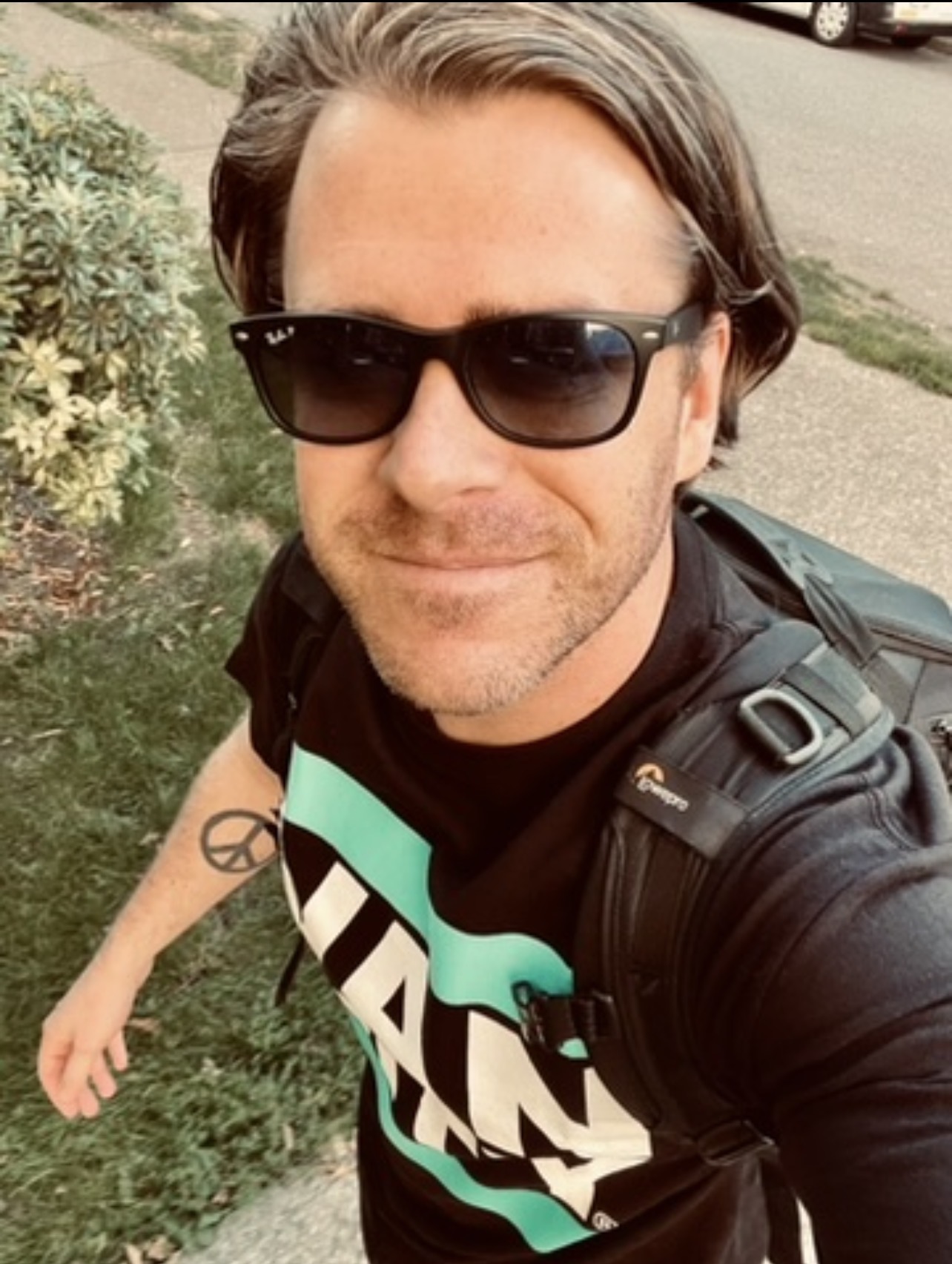
Michael Caswell
Concert photographer. Independent researcher. Based in Vancouver, BC.
Drift was built by one person over several years. The work started as a research tool and became an instrument. That's the whole story.
Seen in the dark. Released into the light.
An equation that
shouldn't exist.
While working on an independent research project, a pattern emerged across two completely different frameworks for understanding meaning — one mathematical, one linguistic. A convergence that had no reason to exist.
Verifying it required building tools to translate between completely different ways of knowing — the precise language of mathematical proof and the interpretive logic of ancient scholarship. Two worlds that don't naturally speak to each other.
DRIFT is what you get when you generalize that translation problem into an instrument. Not just between those two frameworks, but across any two points in the space of how human beings have understood the world.
Concert photography
since before the algorithm
For over a decade, shooting in the photo pit — festivals, clubs, arenas. The discipline of working in controlled chaos, capturing a single unrepeatable moment in low light with one chance, informs how Drift is designed.
The instrument metaphor isn't incidental. Drift is designed to be played, not configured.
Vancouver Concert Photography
The interface you use to make music changes what music you make. Drift is designed so that the act of navigation — turning knobs, moving through coordinate space — produces creative decisions that prompt boxes never would.
Constraints produce creativity. The four axes aren't restrictions — they're the dimensions of a space. Having a space to navigate is what makes navigation possible. Unlimited prompting produces uniform output. Coordinates produce specificity.
How you understand the world shapes what you say and how you say it. Moving along the time axis isn't just a stylistic change — it's a change in the fundamental relationship between the speaker and truth. Different worldviews produce genuinely different music.